Showing posts with label redecorating. Show all posts

Monday, July 15, 2019

Adventures in DIY Flooring - Cutting the Rug VIII


If you have been popping in to check on things here, you know that I've been focusing on remodeling our library/studio/auxiliary guest room. That room was the last of the carpet and I decided that while the room was completely empty and before the new floor was installed I would take care of all the other issues and start turning this room more officially into a capital-L Library*:
When those were done, I finally tackled the floor! I forgot to take photos of the carpet specifically, but here it is with removed wainscot and chair rail on it. Ick.


I decided to forego all the in-progress shots, since you can see those in the other Adventures in DIY Flooring posts should you choose. But know that Eric again helped with installing the self-leveling underlayment - it would havbe been brutal without him. After that I spent a few hours over three days doing some patching and then it took me three short-ish days to get the LVP laid down.

Almost halfway! Somewhere around 40% done I cut a chunk off the end of my left index finger, so that was... eventful.
And the floors are done! Well, except that last bit that will abut the bookcases when that gets done.
This photo has the more accurate floor colors.

Then I tidied up the base moulding and reinstalled most of it. I want to build bookshelves across that entire unfinished wall this autumn, so am leaving the base moulding off there. I think we'll replace the baseboard heater then, too, so that piece is staying off, too. I had assumed baseboard heaters would cost a couple hundred bucks, so never considered replacing an of ours which are in pretty sorry shape, but that we hardly ever use. Their paint is worn and scratched, as well as speckled with paint and stain from all the years the other owners have painted and stained. But it turns out that new ones are not even one-hundred dollars! It also turns out that the electrician that the home warranty insurance had come out to replace the once in the living room our first year here, was a liar as well as a flake. He said they didn't make them as long as the one he was replacing any more, but Lowe's has them in stock right now. Maybe they didn't make them 6 years ago, but I have very serious doubts. Anyway, I can see replacing most of them over the next few years and updating the controls while we're at it. 


In addition to the wall o' books, this room will also be getting new window coverings and a picture rail. I will still use it for sewing and crafting until we can kit out the shop as a studio, but am dedicated to really trying to keep it tidy and contained. Eventually we'd like to move the TV out of the living room, have comfortable watching reading furniture in here, as well as some kind of portable/fold-away desk for Eric to write at. We need to get this room's current furnishings out of the guest room and hallway, as we're expecting some guests over the next few months, so it's going to be awhile before this room is "done."

Where the bookcases will be!


*I've been calling that series "Overbooked?" because... we have A LOT OF BOOKS in addition to the books on the shelves that came with the guest room and on the shelves I added in the guest room closet.


I have forgotten and procrastinated on ordering another transition piece for the doorway, so there is that to finish, too. It didn't take too long to get it last time; I hope to pop in there to order it soon as well as return three (3) unopened boxes of the LVP. I will keep 2+ boxes for repairs and whatnot.


Monday, July 1, 2019

Adventures in DIY Flooring - Cutting the Rug VII


I took a bit of a breather before tackling the last room - like several months, but before that there was this one last little bit to share: the "transition pieces."

I'm used two kinds; a T-mold and a stair nose. The T-mold was installed in October and is in the door ways and was not a requirement of the material... COOL FACT: this VPL can cover floors up to 300 feet long without requiring transition pieces. NOT-COOL TARA: I just couldn't empty the entire upstairs all at once and/or do all the math with the separate rooms and the not-perfectly-square rooms to manage to do it all without breaks. I'd rather that we didn't have to have the transitions in the doorways, but...

Two of the three that are completed so far. Visually, it's really subtle where it follows the same direction as the planks and it's not egregiously noticeable where it crosses the planks. Their overall profile is shallower than many of these kinds of transition pieces for other types of flooring.


The stair nose is tricky, because of the self-leveling underlayment and issues with the way the top stair riser was... let's call it "slightly janky," and the way the original underlayment was... let's say "slightly janky."


So I got this far (see below) and then it has stayed that way for... months. Not twelve months, but quite a few. In fact it is that way now, because there is always something less scary to work on. You see, I still need to build up that edge. I didn't realize I'd need to make up for the self-leveling underlayment, etc. D'oh!


I know these little threshold bits are boring. I also know that it was a bit nerve racking to install because a not-quite-eight-foot-length of each of these things were kind of spendy and I didn't want to mess them up. So, I had to share my success! And also share my super technical technique using super specialized special tools for holding the pieces in place while the adhesive dried.


Cast iron cookware: is there nothing it can't do?


Unforeseen additional steps:

I had to pull up and reinstall the planks in the hall and guestroom. Ugh and oof. While I did follow directions very closely from the very beginning when installing the LVP , I didn't quite get it right. There were some joins that I didn't notice hadn't quite clicked together until I was "done" which I thought felt was noticeable underfoot and looked so, too. I assumed this would also effect the longevity of the floor. Because I was very careful when pulling the planks up and stacked them in order course-by-course, I was able to reuse the same pieces with just just a few exceptions. It went A LOT faster since pretty much all the cutting was already done. Sure, it was a drag to have to empty the rooms of furniture, clear the closet floor, and pull up all the base mouldings, but I think it was worth it and I'm glad I (re)did it. I'm also glad I noticed before I started the master suite and bathroom so I could get it right from there and I'm really glad it's over.

Yeah, yeah. They're called "cups," but they're a lot more like a coaster as far as I'm concerned, so that's what I'm going to call them.

When I was pulling up the planks in the guest room I noticed that the bed feet had dented the surface. As per manufacturer instructions, I had added felt feet, but that only protected the surface from scratch-type wear, not dents. So, I picked up coasters for the bed feet. These are the kind made for carpet - they have a felt-like/fabric surface against the floor. The LVP manufacturer also recommends against rubber backed rugs and rubber rug pads, so I have to assume the rubber-bottomed coasters meant for hard surface flooring would not be recommended either. Hopefully, by avoiding running and throwing ourselves onto the guest bed we can keep it from sliding around too much! The master bed frame already has broad feet to distribute the weight better - and 6 of them at that.


Tuesday, June 25, 2019

Overbooked? Making our Library Space 1G


Guess what! Something was early! Shocking, I know. I just happened to go to the website to look at the light fixture and it was in stock! If they sent me the email I signed up for, I did not see it. They did send me snail mail with a 10% off your purchase coupon code that I did see, so at least there is that! Annnnd it showed up intact and when it was supposed to. Of all things.

You can't see if from this side, but there is a gap where there is no drywall in a few spots where the canopy touches the ceiling. But look how nice that brass is with the blue!

Even though the brass is a little, well, brassier that I was expecting, I'm rather smitten with it. What I am not smitten with, or rather who, is the person who hung the drywall in this place. Just like pretty much every other one in the joint, they cut too large of a hole for the electrical box. And dang if I could find a small, simple, plain ceiling medallion.

It's the Eveleth 3-light Semi-flush Mount from Wayfair's Wrought Studio Shop. I am trying GE's Reveal LED bulbs, hoping that they'll have the benefits of LEDs, but with a nicer quality of light.

Hey look! Some holidays in the new ceiling paint, too! The new color is Benjamin Moore's OC-27 Balboa Mist.

Before I go on about that situation, can we take a moment to appreciate that the milk glass globes are open on the bottom while still covering the light bulbs? Yes! Let's appreciate the open bottom for all the bugs who are not going to crawl in there, die, and make gross silhouettes! I also really like how there are three of them - I do so prefer odd numbers for this kind of thing.

I found and pinned a couple of medallions that were OK, but merely OK. So I decided to try to repair/fill the drywall. I was going to have to take down the light whichever option I chose. Some tape, some mud, some futzing around, followed by priming and painting and I'm calling it "h*ckin' good enough!"


A couple days after remedying the drywall situation, the dimmer switch arrived! Since I could not have my nearly invisible, yet somehow sexy indigo blue switch and plate or any kind of close approximation, I went in the completely opposite direction. Old-fashioned and brassy! Luckily, Rejuvenation was having a sale, so getting this button-style dimmer switch and a forged brass cover plate was only a few bucks more than the smart switch I returned. The brass is not lacquered, so I hope it will patina over time to a bit more antique-y finish.

Even though I've totally been living with the original (ungrounded, ahem) switch just hanging out of the wall like this for a couple weeks, you know I protected that Venetian plaster from my own self when the new one finally arrived.


I am crushing hard on the blue with the brass and wood tones. Spending my early adulthood in the shiny, brass-plated doorknob years adversely effected and limited my understanding of what brass is. I'm glad that through various human and media sources I have been exposed to how much more brass can be.


Also suitable for Mid-century Alien Autopsies.


As a reminder, this is the old light. I don't hate the base or the shade, but I don't particularly like them together and they weren't adequate lighting for the activities this room supports. When I took it down I found that the fixture's wires were cloth-covered, so apparently it's an old one! I would like to reuse it somewhere, so I'm going to keep it and look into bringing the wiring up-to-date.


COMING NEXT: I'll be shifting gears back to the ol' Cutting the Rug Series while install the new LVP flooring in this room which is the last room. "THE LAST ROOM!" she said jinksingly.

______________________________________________________________

THE BREAKDOWN

Phase I
1. Empty that room!
2. Remove base moulding
3. Remove closet doors & hardware
4. Remove the carpet and pad
5. Remove tack strips and staples
6. Remove chair rail and paneling
7. Determine if wall paper is removable
8. repair walls
9. prime walls and ceiling
10. paint walls and ceiling
11. decorative finish(es)?
12. replace light fixture (back-ordered, supposed to be available July 7)
13. replace switches and outlets, covers (waiting on that dimmer)
14, make and install closet shelves, etc. (will install the bottom shelf after the floors are installed)
15. prime existing subfloor x 2
16. pour self-leveling subfloor
17. install LVP
18. reinstall base moulding
19. reinstall closet doors
20. install transition piece at doorway
21. make window covering
22. install window covering

Phase II
1 - ?. Build built-in bookshelves
... Finish last course of flooring
... Add base shoe or other moulding to bookcases
... Add picture rail


Wednesday, June 12, 2019

Overbooked? Making our Library Space 1E


[Deep breath in]

My plan was that once the walls and ceiling were finally fixed and fancified and the outlets and switches replaced and plated, I would finally tackle the closet. But instead, I was waiting for what was supposed to be a 2-day delivery of more Venetian plaster, but was in fact a nearly 2-week delivery*. Also there was a snafu with the dimmer switch - oy. I had to switch gears entirely on that which bums me out, but that's the way these things go, I guess. You see, I had found and ordered these great switches and outlets which you will see in the next post. They blended right in with the indigo blue wall finish! The problem is that the dimmer switch was a "smart switch" which means it requires a neutral wire to function at all. Of course our 1976-built house isn't wired with those and the only solutions were either to have an electrician add one between the light and the switch or to find a "dumb" dimmer. I was not excited about spending what would probably be a couple hundred dollars just for this one wire. Eric is vehemently opposed to adding smart technology to the house, because personal security/privacy technology has not kept up with the smart technology.  Neither of us are having anything to do with any smart speakers, etc. so this made sense to me. I made sure that this product line did not include a non-smart dimmer (it did not), searched for another company that might have a similarly colored, non-smart dimmer (I found none), then decided to go a completely different way with the main light dimmer switch (but not the closet light switch or the outlets). My beautiful blue switch and its plate were returned and the Plan B switch and plate ordered (on sale!).

[Deep breath out]

So  decide to start on the closet while waiting on that. Even with all the disappointment and frustration of the dimmer switch debacle fresh and tender, it's still ridiculously satisfying to have this closet spruced up and made more suitable to our needs.

[Satisfied sigh]

Here is how the closet was when we moved in. Well, it came to us with doors, base moulding, and that carpet, but I removed all of those at the beginning of this project. They'll all get reinstalled after the floor goes in... except the carpet, of course.

[Shudders]

I consider us lucky that there are lights in the 2nd and 3rd bedroom closets. At least with this one, the switch is at or pretty close to standard height.

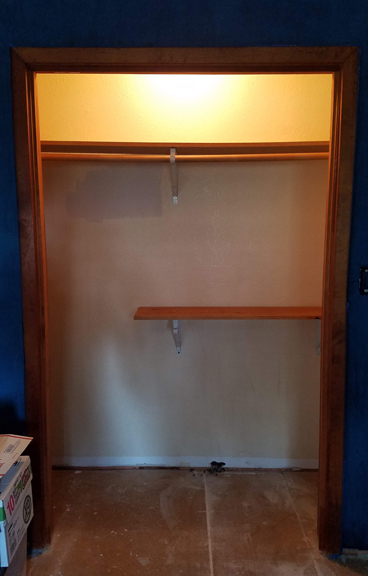
First, I took out the shelves and rods along with the hardware. Second, I repaired and painted the walls. Heck, I painted the ceiling, too.

Let's pretend there is a comma after "no" up there.

If you're wondering why the space outside the closet seems dark, it's because I did this work and took this photo before reinstalling the old main light switch, so the room itself was a little dim.

Third, I got new materials: brackets and shelving which I had cut to size at the store for the shelves on the right. The top shelf I custom cut myself. Then to the exposed cut areas I added the iron-on tape sold for this purpose. I determined that I could stall the top shelf a little higher if it was not the full 24" depth where it passed behind the door, because it would leave more space for fitting larger boxes and such. I didn't want to lose any storage space I didn't have to, so I decided to try this instead of just putting in a 12" shelf all the way across or trying to wrangle three different shelves at the same level.


After the floor is installed and the base moulding back up, I'll put in that last shelf.
MAXIMIZIN' THAT CUBIC AREA STORAGE LIKE A BOSS!

It would have been nice to be able to reuse the shelves that were in the closet as a start, but this is not for storing our clothing, it is for storing craft, art, and sewing supplies so I want to utilize every cubic inch that I can which means shelves the full depth of the closet. I did get to reuse the brackets that hold the closet rod and the rod itself.

A place to hang the big stencils, sewing projects, life-sized skeletons, etc. and to keep the wide rolls of upholstery and vinyl.
Of course what would have only taken a couple hours to accomplish actually took several days due to none of the 4 hardware/building materials retailers within 10 miles of here had particle board screws or anything with the appropriate threads in a short-enough length. Because apparently none of the professionally installed particle board shelving going into ALL the closets around here is installed using best practices. Annnnnd I imagine that's the case everywhere and it's just me being persnickety. I'm OK with that.


One last shelf will go in on the bottom right after the floor is done.

[Whoop]

Getting this part of the project checked off the list really helped the upstairs feel a bit more livable since many of the crafting materials that had been moved out of this room were stored on shelves that had been moved into the hallway. Ugh. We still have all the furniture and some of the stuff that will be stored in the closet stashed in places around the second floor, but this helps a little.

[Satisfied sigh]

*Emails have been sent, 1-star rating left**, product returned, refund issued.
** With specific, rational & non-ranty reasons described in review. Which is when the seller actually decided to respond. Too little, too [expletive] late, M_xW_rehouse.

______________________________________________________________

THE BREAKDOWN

Phase I
1. Empty that room!
2. Remove base moulding
3. Remove closet doors & hardware
4. Remove the carpet and pad
5. Remove tack strips and staples
6. Remove chair rail and paneling
7. Determine if wall paper is removable
8. repair walls
9. prime walls and ceiling
10. paint walls and ceiling
11. decorative finish(es)?
12. replace light fixture (back-ordered, supposed to be available July 7)
13. replace switches and outlets, covers (dimmer switch ordered, but not arrived)
14, make and install closet shelves, etc.
15. prime existing subfloor x 2
16. pour self-leveling subfloor
17. install LVP
18. reinstall base moulding
19. reinstall closet doors
20. install transition piece at doorway
21. make window covering
22. install window covering

Phase II
1 - ?. Build built-in bookshelves
... Finish last course of flooring
... Add base shoe or other moulding to bookcases
... picture rail


Wednesday, May 22, 2019

Overbooked? Making our Library Space 1D


I have been ogling indigo/brass/wood interiors for the last year or so. I thought it would be hard to sell Eric on this, but it was not. YEY! So, I dug out my paint decks* and narrowed my choices down over a few days while checking out how the samples looked at different times of day. The hardest part was choosing a ceiling color. I did not want white. I also did not want to just carry the wall color up onto the ceiling which is something I frequently do like. But then Eric bought new running shoes and guess what colors they are. Go on, guess. Yup, like navy blue, brass and a warm, light greige. Huh.

I do not have the skills to make an interesting photo of the ceiling and its decidedly not-white or ivory color, so here's this one.

Speaking of lacking photography skills, there is this photo of the walls. 

How about this pic, then? Nope, still no good, but I was excited enough about getting the color up that I took one.

These are a big commitment, so I decided to take advantage of the Benjamin Moore Sample Pints. Luckily, I loved them! They are 2061-20 Champion Cobalt and OC-27 Balboa Mist. Also. luckily my local Authorized Benjamin Moore Retailer sold me the tint for Champion Cobalt so I could mix some Venetian Plaster. WOO!


*This is not true! I had done this way before even mentioning this colorway to Eric. [wink]
______________________________________________________________

THE BREAKDOWN

Phase I
1. Empty that room!
2. Remove base moulding
3. Remove closet doors & hardware
4. Remove the carpet and pad
5. Remove tack strips and staples
6. Remove chair rail and paneling
7. Determine if wall paper is removable
8. repair walls
9. prime walls and ceiling
10. paint walls and ceiling
11. decorative finish(es)?
12. Replace light fixture (back-ordered, supposed to be available July 7)
13. Replace switches and outlets, covers
14, make and install closet shelves, etc.
15. prime existing subfloor x 2
16. pour self-leveling subfloor
17. install LVP
18. reinstall base moulding
19. reinstall closet doors
20. install transition piece at doorway
21. make window covering
22. install window covering

Phase II
1 - ?. Build built-in bookshelves
... Finish last course of flooring
... Add base shoe or other moulding to bookcases
... picture rail

Sunday, May 19, 2019

Overbooked? Making our Library Space 1C


I struggled to get excited about getting started with this room. I thought I'd start demo in February. And then we got DUMPED ON by the Snow Gods in Feb and I spent a goodly portion of many days dealing with snow removal, sometimes plowing & shoveling twice a day for at least an hour each time. I honestly don't remember exactly when I really got started emptying the room, but it was probably near the end or March or beginning of April. For some reason, I didn't remember that once I got past the Undoing Phase and onto the Doing Phases, I would feel that old enthusiasm. Or at least some of it. Sigh.

You may notice a slight difference in color on the left and right. The left is the still-wet second layer of skim coat, the right is the dry first layer. My trusty hawk and trowel sit on my trusty step stool.

Since my last post, I have A) primed the seriously damaged drywall substrate I was left with after removing wallpaper and fake paneling (no photo), B) skim-coated the appropriate walls, and C) primed those walls, and D) primed and painted the ceiling.

Paint this knock-down (i.e. "brocade") textured ceiling is a humongous pain in the butt. Even with the long-nap roller, the priming, the slow and tedious attention to every stroke the first coat was riddled with holidays. Brining in the halogen work light helped a lot with the second coat, but boy did this whole thing go a long way to supporting my personal distaste of this texture.

I know most people love light-and-bright, but dark-and-cozy is my jam, so it was a little it of a thrill to get this darker grey primer up in preparation for the dark, indigo blue.

I have also ordered some Modern Masters brand (acrylic) Venetian Plaster in the Ultra Deep Tint Base, and picked up sample pints/quarts of paint to give the colors a test run, then gone back to purchase a gallon of each. I also did a test tinting of the Venetian Plaster with tint purchased when I picked up the gallons.


______________________________________________________________

THE BREAKDOWN

Phase I
1. Empty that room!
2. Remove base moulding
3. Remove closet doors & hardware
4. Remove the carpet and pad
5. Remove tack strips and staples
6. Remove chair rail and paneling
7. Determine if wall paper is removable
8. repair walls
9. prime walls and ceiling
10. paint walls and ceiling
11. decorative finish(es)?
12. Replace light fixture
13. Replace switches and outlets, covers
14, make and install closet shelves, etc.
15. prime existing subfloor x 2
16. pour self-leveling subfloor
17. install LVP
18. reinstall base moulding
19. reinstall closet doors
20. install transition piece at doorway
21. make window covering
22. install window covering

Phase II
1 - ?. Build built-in bookshelves
... Finish last course of flooring
... Add base shoe or other moulding
... Add picture rail moulding

Thursday, May 9, 2019

Overbooked? Making our Library Space 1B


Demo is mostly accomplished! Tearing out the carpet and pad were the least of the issues. All that kneeling and crouching wasn't super comfortable, but that part of the demolition was straightforward and surprise-free. I realized after the fact that I don't think I took a photo of just the carpet, but this one gives you the idea; dingy tan shag with really obvious seams.


What you see sitting on the carpet is a piece of the fake paneling, some of the base moulding, a piece of the plastic moulding that went with the paneling, and the end of a piece of the chair rail. Speaking of all that, look what that paneling did to the wall! Why? Well, instead of using panel nails, they used panel adhesive. I realize that's probably standard, but I sure wish more people in the industry on all sides would consider more carefully the un-doing of their products when designing and executing their installation methods. This is what "the next guy", me in this case, is left to deal with.


I'm just trying to remember to be grateful that they paneled not quite half the room and only to chair rail height. There is at least a sheet of this stored in the shop loft, so it really couldn't been worse.


ANNOUNCEMENT: 

THERE IS A REASON THERE IS A DRYWALL TEXTURE SPECIFICALLY FOR APPLYING WALLPAPER! 


Anyway... the wallpaper. Oh, sweet baby Bigfoot, the wallpaper! The steamer could not handle the painted-over-ness of it. This method has worked for me in the past, but not this time. Sigh. And indeed, just like every single other roll of the stuff in this house, it was applied directly to the drywall which at least this time seems to have been primed. Still, this is what removing it did. Those dark spots are the torn drywall paper bits. Admittedly, this is the worst of it as I got better at finessing it off as I continued around the room.


BONUS BITCHING! During all of the various projects we've done around here over six-and-a-half years, there have been a few, repeated, uh..., issues that indicate that whoever did the drywall here, was not an expert. Or even really especially competent. The first thing we noticed, and by far the most common issue, is that just about every single hole for the electric boxes - switches, outlets, and fixtures - is cut too large. This means that the outlets are not secure and that some plates and most of the light fixtures we've bought to replace the old, dated ones do not cover the holes. I'll replace the outlets and switches to fix these. I've had to add small medallions on three ceiling fixtures in the house so far and hope that I won't have to do another.

But that's not what I want to show now. What I want to show now are these examples of what I'm starting to think of as Bullshit Workmanship.


Yes, that's the same image as the first in this post. Apparently there was some kind of significant savings in time or money to not finish the corners behind the chair rail. Oh, and this. This part where they didn't think that the whole surface above the closet opening needed drywall, just allllmost all of it. It's not just this little bit either, it's all along that top edge.


______________________________________________________________

THE BREAKDOWN

Phase I
1. Empty that room!
2. Remove base moulding
3. Remove closet doors & hardware
4. Remove the carpet and pad
5. Remove tack strips and staples
6. Remove chair rail and paneling
7. Determine if wall paper is removable
8. repair walls
9. prime walls and ceiling
10. paint walls and ceiling
11. decorative finish(es)?
12. Replace light fixture
13. Replace switches and outlets, covers
14, make and install closet shelves, etc.
15. prime existing subfloor x 2
16. pour self-leveling subfloor
17. install LVP
18. reinstall base moulding
19. reinstall closet doors
20. install transition piece at doorway
21. make window covering
22. install window covering

Phase II
1 - ?. Build built-in bookshelves
... Finish last course of flooring
... Add base shoe or other moulding